Concept
In education, functional architecture often prioritizes efficiency over inspiration, hindering the student experience. Students navigating dull, concrete environments may face cognitive fatigue due to the absence of dynamic elements.
”Prismatic Space” is an architectural and digital intervention designed to break this cycle. By injecting vibrant, shifting light into a mundane transit space, the project transforms a simple staircase into a sanctuary of cognitive restoration.
I use advanced technologies such as Marble AI and 3D Gaussian Splatting to transform heavy concrete into a magnificent stained-glass forest. I also embrace Impressionist principles by using custom GLSL shaders in TouchDesigner to create dynamic “rainbow ribbons” of light and atmospheric effects. This visual stimulus, termed “soft fascination” by environmental psychologists, promotes relaxation and sparks creativity. “Prismatic Space” demonstrates that our environments engage actively in the educational journey. By transforming light and color, we can inspire creativity and enrich learning experiences, envisioning a future where educational spaces nurture both mind and spirit.
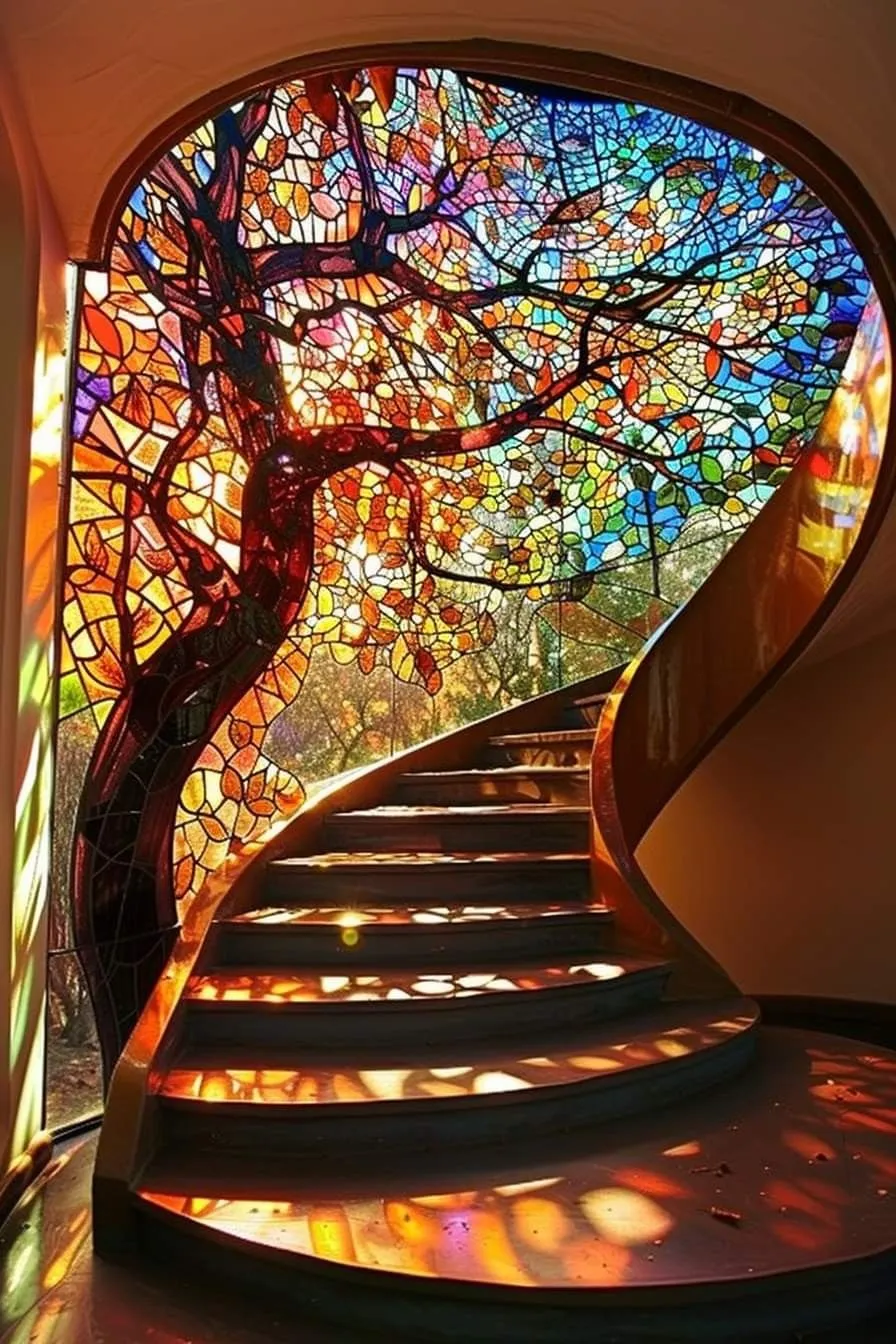
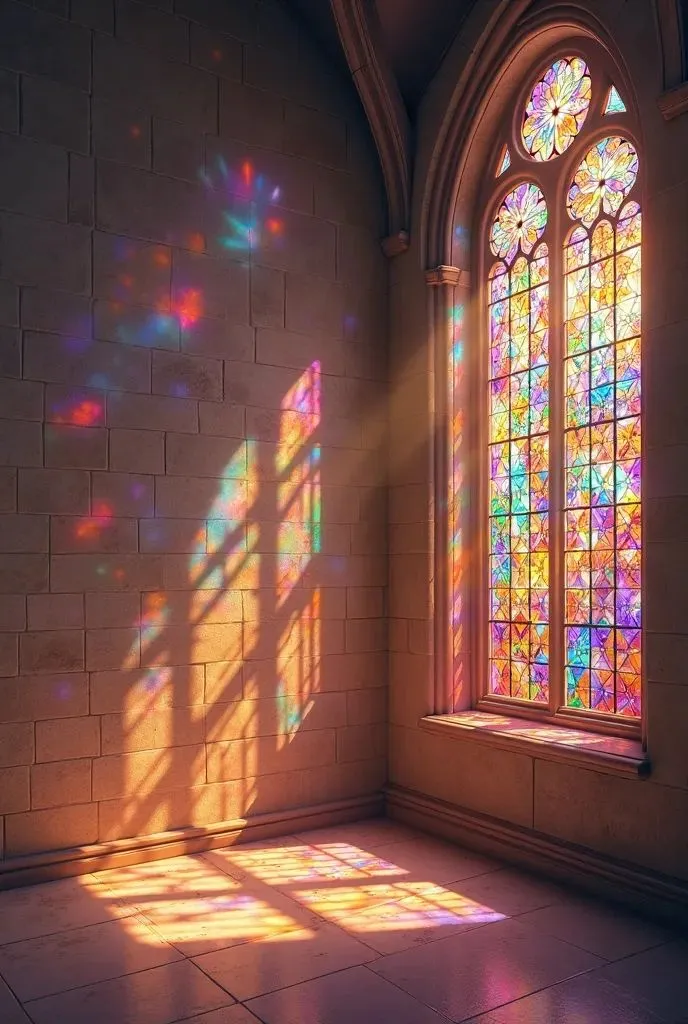
IAA Space
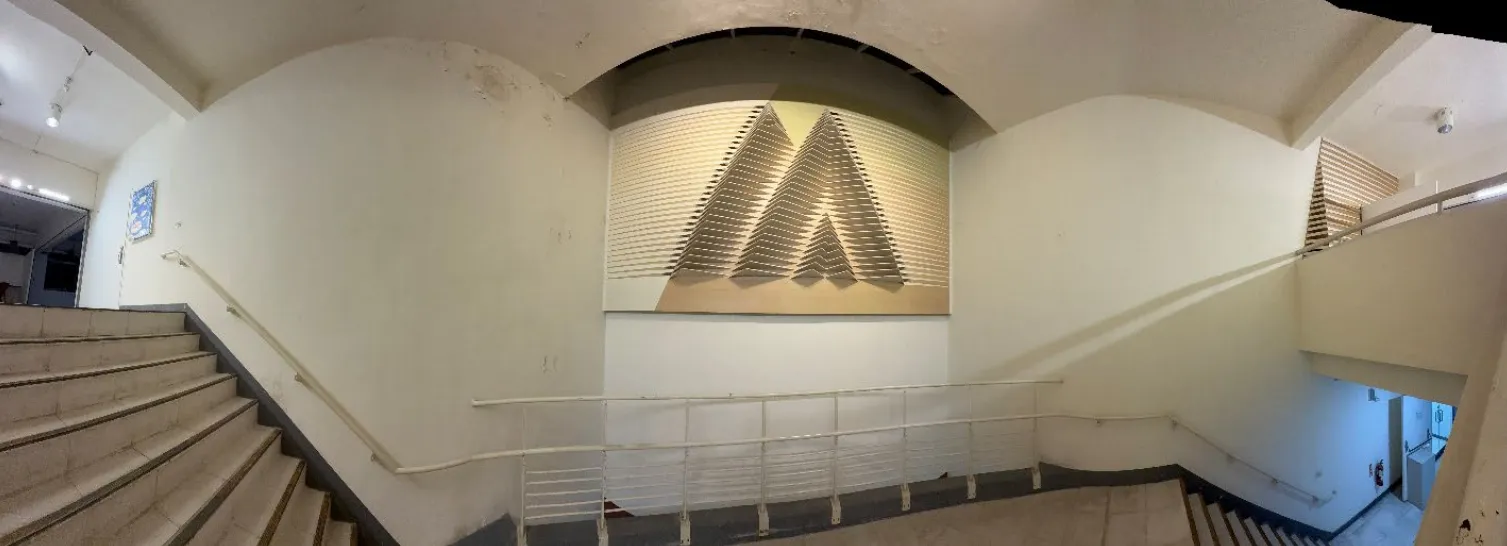
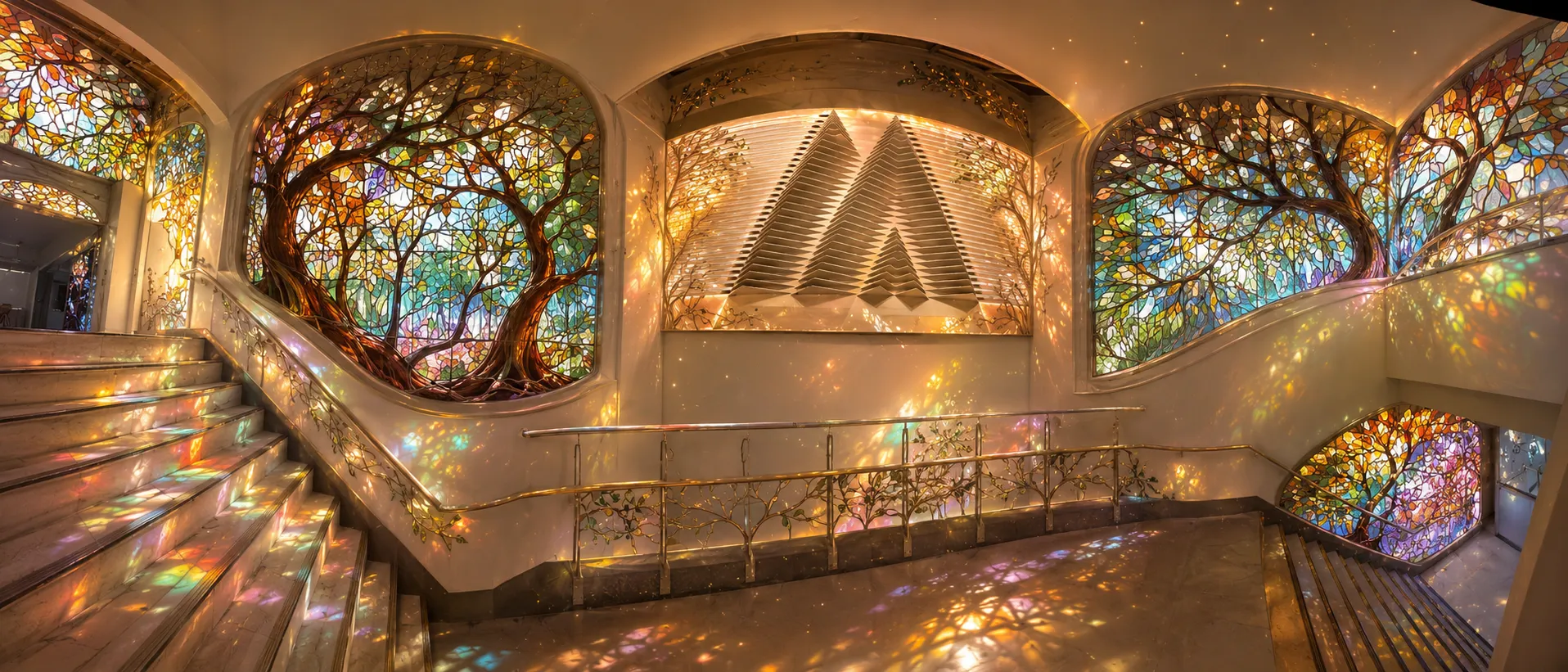
3D space with Marble AI
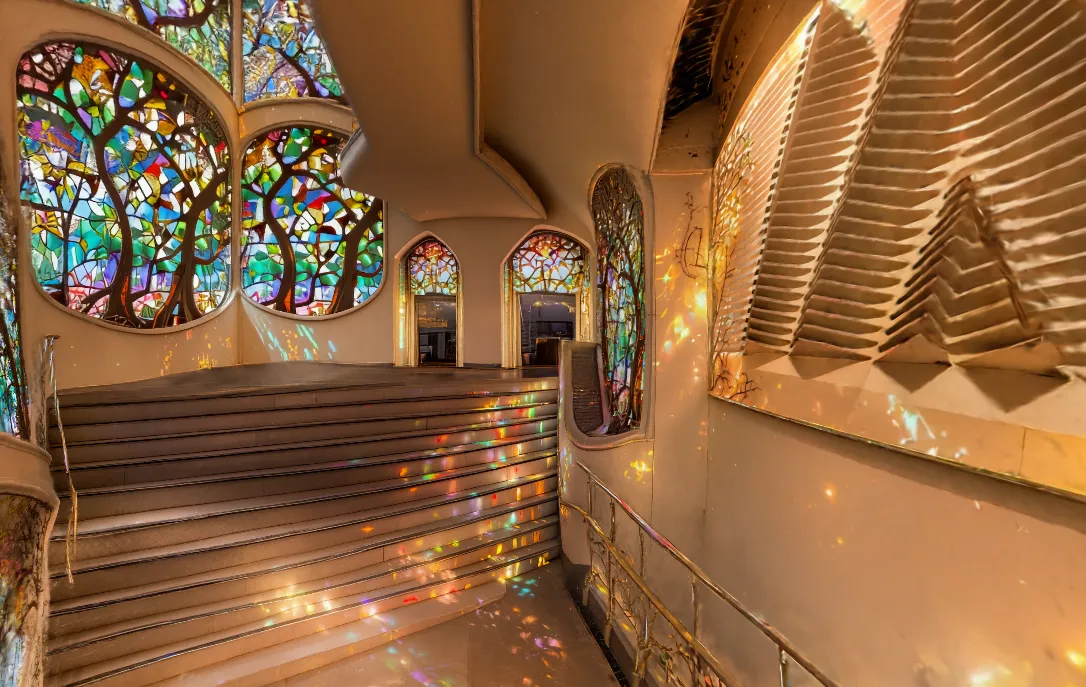
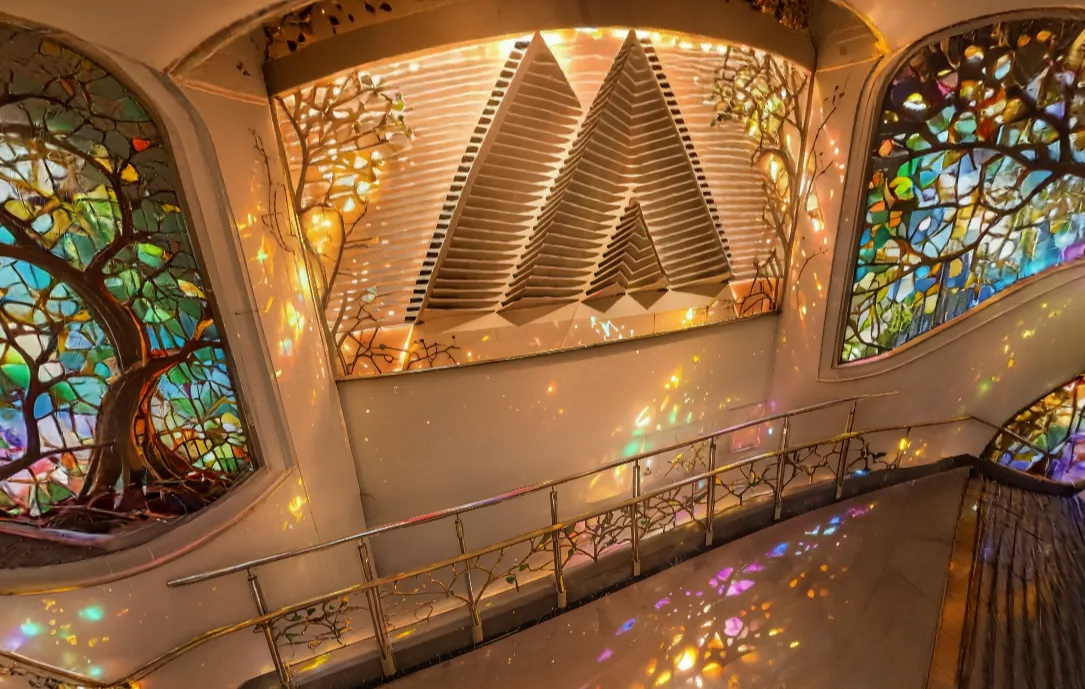
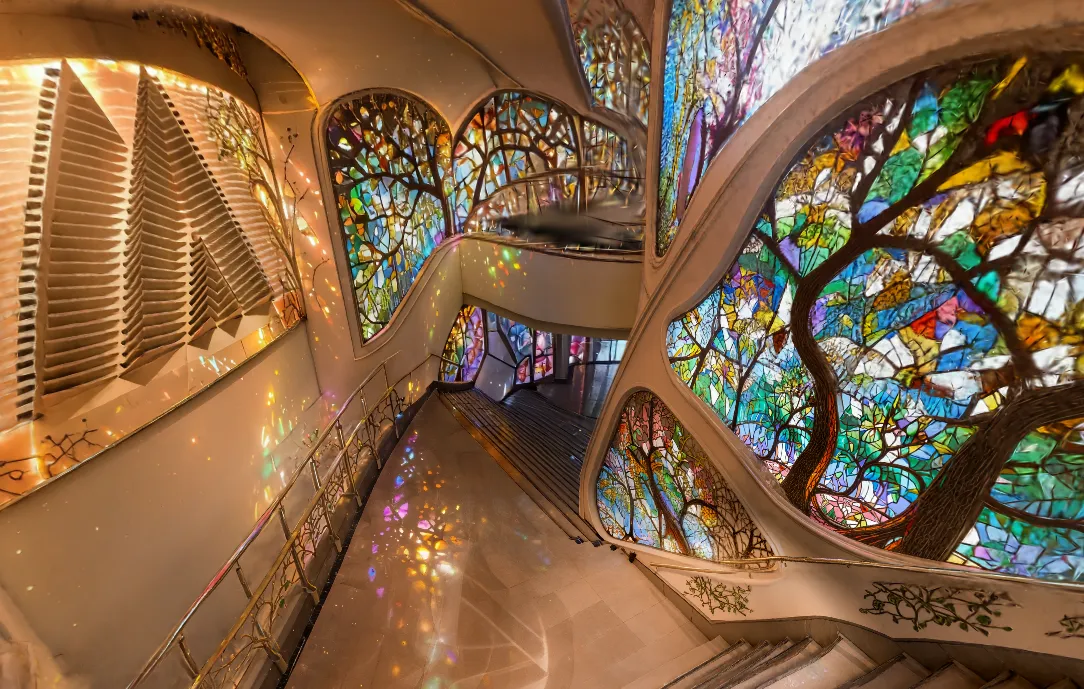
uniform sampler2D sPositions;
uniform sampler2D sRotation;
uniform sampler2D sScale;
uniform sampler2D sColors;
uniform sampler2D sLookup;
uniform vec3 uFocal;
uniform vec3 uT;
uniform vec3 uR;
uniform float uS;
uniform ivec2 uPointResolution;
uniform float uScale;
uniform float uAlphaThreshold;
uniform float u_time;
// --- THE DATA BRIDGE ---
// We added 'camDist' here so the Vertex shader can send true depth to the Pixel shader.
#ifdef TD_VERTEX_SHADER
out Vertex
#else
in Vertex
#endif
{
 vec3 position;
 vec4 color;
 vec2 uv;
 vec3 conic;
 float camAngle;
 float camDist;
} Vert;
// ==========================================
// VERTEX SHADER
// ==========================================
#ifdef TD_VERTEX_SHADER
mat3 RotZYX(vec3 a) {
 vec3 c = cos(a), s = sin(a);
 return mat3(
 c.x*c.y, c.x*s.y*s.z - s.x*c.z, s.x*s.z + c.x*s.y*c.z,
 s.x*c.y, c.x*c.z + s.x*s.y*s.z, s.x*s.y*c.z - c.x*s.z,
 -s.y, s.z*c.y, c.y*c.z
 );
}
mat3 quatToMat3(vec4 q) {
 float qx = q.y, qy = q.z, qz = q.w, qw = q.x;
 float qxx = qx*qx, qyy = qy*qy, qzz = qz*qz, qxz = qx*qz, qxy = qx*qy, qyw = qy*qw, qzw = qz*qw, qyz =
qy*qz, qxw = qx*qw;
 return mat3(
 vec3(1.0 - 2.0 * (qyy + qzz), 2.0 * (qxy - qzw), 2.0 * (qxz + qyw)),
 vec3(2.0 * (qxy + qzw), 1.0 - 2.0 * (qxx + qzz), 2.0 * (qyz - qxw)),
 vec3(2.0 * (qxz - qyw), 2.0 * (qyz + qxw), 1.0 - 2.0 * (qxx + qyy))
 );
}
mat3 RotScale(vec4 rot, vec3 scale, float globalScale) {
 mat3 ms = mat3(
 uS*globalScale*exp(scale.x), 0, 0,
 0, uS*globalScale*exp(scale.y), 0,
 0, 0, uS*globalScale*exp(scale.z)
 );
 return ms*quatToMat3(rot)*RotZYX(radians(uR.zyx));
}
vec3 Covariance(vec3 p, int cameraIndex, mat3 sigma) {
 mat4 camMatrix = uTDMats[cameraIndex].cam;
 vec2 limit = 1.3 * uFocal.xy;
 vec4 camPos = camMatrix*vec4(p,1.);
 camPos.xy = clamp(camPos.xy/camPos.z, -limit, limit)*camPos.z;
 float focal = uFocal.z;
 mat3 J = mat3(
 focal/camPos.z, 0., -(focal*camPos.x)/(camPos.z*camPos.z),
 0., focal/camPos.z, -(focal*camPos.y)/(camPos.z*camPos.z),
 0, 0, 0
 );
 mat3 T = mat3(uTDMats[cameraIndex].camInverse)*J;
 mat3 cov = transpose(T)*transpose(sigma)*T;
 return vec3(cov[0][0] + .3, cov[0][1], cov[1][1] + .3);
}
void main() {
 int instanceIndex = TDInstanceID();
 int vertexIndex = int(gl_VertexID/4);
 int index = instanceIndex * 1024 + vertexIndex;
 int cameraIndex = TDCameraIndex();
 ivec2 inRes = uPointResolution;
 ivec2 xy = ivec2(index % inRes.x, index / inRes.x);
 vec2 lookupData = texelFetch(sLookup, xy, 0).xy;
 int lookupIndex = int(lookupData.y);
 xy = ivec2(lookupIndex % inRes.x, lookupIndex / inRes.x);
 vec3 pos = P;
 vec2 uv = P.xy;
 vec3 conic = vec3(0.);
 vec2 ndc = vec2(0.);
 vec4 color = texelFetch(sColors, xy, 0);
 mat3 m = mat3(1);
 vec4 posData = vec4(0.), rotData = vec4(0.);
 vec3 scale = vec3(0.);

 if (color.a > 0.0 && lookupData.x > 0 && lookupData.x < 1e5) {
 posData = texelFetch(sPositions, xy, 0);
 rotData = normalize(texelFetch(sRotation, xy, 0));
 scale = texelFetch(sScale, xy, 0).xyz;
 m = RotScale(rotData, scale, uScale);
 mat3 sigma = transpose(m)*m;
 vec3 cov = Covariance(posData.xyz, cameraIndex, sigma);
 float det = cov.x * cov.z - cov.y * cov.y;
 conic = vec3(cov.z,-cov.y,cov.x)/det;
 vec2 wh = 2.*uFocal.xy * uFocal.z;
 vec2 quadwh_scr = 3.*sqrt(cov.xz);
 ndc = 2.*quadwh_scr / wh * smoothstep(0.0,0.1,uScale);
 } else { posData *= 0; color *= 0; }

 vec4 worldSpacePos = TDDeform(posData.xyz);
 vec3 camPos = (uTDMats[cameraIndex].camInverse * vec4(0.0, 0.0, 0.0, 1.0)).xyz;

 // --- TRUE DEPTH CALCULATION ---
 vec3 toCamRaw = camPos - worldSpacePos.xyz;
 vec3 toCam = normalize(toCamRaw);
 float camAngle = atan(toCam.x, toCam.z);
 vec4 projectionSpace = TDWorldToProj(worldSpacePos);
 projectionSpace /= projectionSpace.w;
 projectionSpace.xy += ndc*pos.xy*1.0;
 gl_Position = projectionSpace;
 Vert.position = projectionSpace.xyz;
 Vert.color = color;
 Vert.uv = uv;
 Vert.conic = conic;
 Vert.camAngle = camAngle;

 // Pass the true physical distance down to the Pixel Shader!
 Vert.camDist = length(toCamRaw);
}
#endif
// ==========================================
// PIXEL SHADER
// ==========================================
#ifdef TD_PIXEL_SHADER
out vec4 fragColor;
float sdCircle( vec2 p, float r ) { return length(p) - r; }
float sdFish(float i, vec2 p, float a) {
 float ds, c = cos(a), s = sin(a);
 p *= 1.3*mat2(c,s,-s,c);
 p.x *= .97 + (.04+.2*p.y)*cos(i+9.*u_time);
 ds = min(length(p-vec2(.8,0))-.45, length(p-vec2(-.14,0))-0.104);
 p.y = abs(p.y)+.13;
 return max(min(length(p),length(p-vec2(.56,0)))-.3,-ds)*.05;
}
float glow(float d, float str, float thickness){return thickness / pow(abs(d), str);}
void main()
{
 vec4 color = Vert.color;
 if (color.a == 0) discard;
 vec2 d = Vert.uv;
 vec3 conic = Vert.conic.xyz;
 float power = -.5*(conic.x * d.x * d.x + conic.z * d.y * d.y) - conic.y*d.x*d.y;
 color.a = min(0.99, color.a * exp(power));
 if (power > 0. || color.a < max(uAlphaThreshold,1./255.)) discard;
 TDCheckDiscard();
 // --- 1. PULSING NEON STAR ---
 vec2 p = Vert.uv * 2.5;
 float c = cos(u_time), s = sin(u_time);
 p *= mat2(c, s, -s, c);
 const float an = 3.14159265 / 5.0;
 const float en = 1.0 / 2.0;
 vec2 acs = vec2(cos(an), sin(an));
 vec2 ecs = vec2(cos(en), sin(en));
 float bn = mod(atan(p.x, p.y), 2.0 * an) - an;
 p = length(p) * vec2(cos(bn), abs(sin(bn)));
 p -= 0.4 * acs;
 p += ecs * clamp(-dot(p, ecs), 0.0, 0.4 * acs.y / ecs.y);
 float dist = length(p) * sign(p.x);
 float glowAmt = 0.02 / max(abs(dist), 0.001);
 glowAmt *= (0.5 + 1.5 * sin(u_time * 1.5));
 float shapeAlpha = smoothstep(0.02, 0.0, dist);
 color.a = color.a * max(shapeAlpha, glowAmt);
 color.rgb = color.rgb * shapeAlpha + (color.rgb * glowAmt * 2.0);
 // --- 2. GLOBAL SUNLIGHT RIBBONS ---
 vec2 screenPos = gl_FragCoord.xy * 0.001;
 float rc = cos(0.8);
 float rs = sin(0.8);
 vec2 rayPos = mat2(rc, rs, -rs, rc) * screenPos;

 float wave1 = pow(sin(rayPos.x * 7.0 + u_time * 0.3) * 0.5 + 0.5, 10.0);
 float wave2 = pow(sin(rayPos.x * 7.0 + u_time * 0.8 + 2.0) * 0.5 + 0.5, 15.0);

 float ribbon1 = smoothstep(0.4, 0.95, wave1);
 float ribbon2 = smoothstep(0.5, 0.98, wave2);

 vec3 rainbowColor1 = 0.5 + 0.5 * cos(u_time * 0.5 + rayPos.x * 4.0 + vec3(0.0, 2.0, 4.0));
 vec3 rainbowColor2 = 0.5 + 0.5 * cos(u_time * 0.8 + rayPos.x * 6.0 + vec3(1.0, 2.5, 4.0));

 vec3 totalRibbon = (ribbon1 * rainbowColor1) + (ribbon2 * rainbowColor2);
 float ribbonMask = max(ribbon1, ribbon2);
 color.rgb = mix(color.rgb, totalRibbon, ribbonMask * 0.2);
 // --- 3. WANDERING FIREFLY ---
 float randomSeed = fract(sin(dot(Vert.color.rgb, vec3(12.9898, 78.233, 45.164))) * 43758.5453) * 100.0;
 float t = u_time * 0.8 + randomSeed;

 vec2 fireflyPos = vec2(
 sin(t * 1.1) * cos(t * 0.83),
 cos(t * 1.3) * sin(t * 0.71)
 ) * 2.5;

 float ffDist = length((Vert.uv * 5.0) - fireflyPos) - 0.01;
 float ffGlow = 0.010 / max(abs(ffDist), 0.0005);

 float blink = pow(sin(u_time * 2.5 + randomSeed) * 0.5 + 0.5, 6.0);
 ffGlow *= blink;

 vec3 ffColor = vec3(1.7, 1.0, 0.2) * ffGlow * 3.0;
 color.rgb += ffColor;
 color.a = max(color.a, ffGlow * 0.5);
 // --- 4. DEPTH-BASED FOG (Atmospheric Perspective) ---
 // We are now using the true physical distance calculated in the Vertex Shader!
 float distFromCamera = Vert.camDist;

 // ADJUST THESE NUMBERS based on how big your 3D model is
 float fogStart = 2.0; // Where fog begins
 float fogEnd = 20.0; // Where fog is thickest

 float fogThickness = smoothstep(fogStart, fogEnd, distFromCamera);

 vec3 fogColor = vec3(0.9, 0.85, 0.7);

 color.rgb = mix(color.rgb, fogColor, fogThickness * color.a * 0.85);
 // --- OVERLAP FIX ---
 if (color.a < 0.05) discard;
 TDAlphaTest(color.a);
 fragColor = TDOutputSwizzle(color);
}
#endif